Key takeaways
- Local rankings run on proximity, relevance and prominence. You cannot change proximity, so the work concentrates on the other two.
- Your Google Business Profile is the highest-leverage asset you own and the one most often left half-filled.
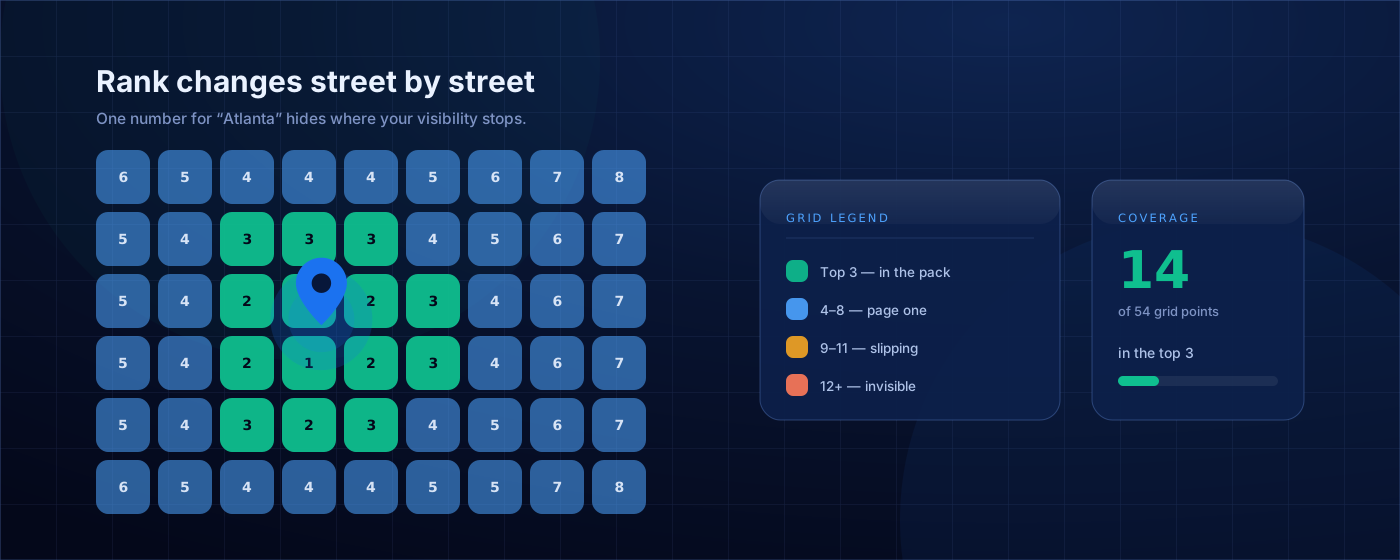
- Rank varies street by street. A single rank number for “Atlanta” hides where your visibility actually stops.
- Reviews influence rankings through volume, velocity and recency — not just star average.
How Google picks the three
Google is explicit about the local ranking factors: relevance, distance and prominence. Understanding what each one means in practice tells you where your effort belongs.
- Distance (proximity) is how far you are from the searcher — or from the location implied by the query. You cannot change it. It is also why a business in Decatur will struggle to appear for a searcher standing in Vinings no matter how good the SEO is.
- Relevance is how well your profile and website match the query. This is highly controllable and routinely under-worked.
- Prominence is how well known and well regarded you are — reviews, links, mentions, and offline reputation reflected online. Slow to build, hard for a competitor to copy.
Because proximity is fixed, local SEO is really the discipline of maximising relevance and prominence hard enough to extend the radius over which you can win. That radius is the number to optimise, and almost nobody measures it.
Your Google Business Profile is the product
For map pack purposes, your profile matters more than your website. Treat it as a page you are optimising, not a form you filled in once.
Primary category is the single biggest lever
Your primary category does more to determine which searches you are eligible for than anything else on the profile. "Contractor" and "HVAC contractor" produce entirely different eligibility. Look at what the businesses currently ranking for your target search have chosen — their categories are visible — and be specific rather than broad.
Fill in everything
Services with descriptions, products, attributes, opening hours including holiday hours, service areas, the booking link, the full business description. Sparse profiles under-perform complete ones, and completeness is free.
The business name field is not a keyword field
"Atlanta's Best Roofing & Gutters | Roof Repair Atlanta" is a policy violation. It sometimes works until a competitor reports it, and then you lose the listing. Use your real business name.
Post, and answer questions
Google Posts and the Q&A section are both public surfaces on your profile. You can ask and answer your own questions — that is allowed and is a good way to get accurate answers in front of people instead of letting a stranger guess for you.
Measure by grid, not by number
"We rank #4 in Atlanta" is close to meaningless. Local rank changes street by street: you might be first in Grant Park, fourth in Old Fourth Ward, and absent in Sandy Springs — all for the same keyword at the same moment.
Grid-based rank tracking samples your position at dozens of points across a map and renders the result as a heat map. It converts a meaningless average into an operational picture: you can see exactly where your visibility ends, and watch that boundary move as the work lands. It also settles arguments about whether a campaign is working, because the map either grew or it did not.
Citations and NAP consistency
Your Name, Address and Phone number appear across directories, data aggregators, social profiles and industry sites. When those copies disagree — an old suite number, a tracking phone number, a former trading name — Google's confidence in your location data drops, and confidence is part of prominence.
- Decide the canonical format once. Exact street abbreviation, exact suite formatting, one phone number. Write it down.
- Fix the big aggregators first, because they propagate to the long tail automatically.
- Clean up duplicates. Duplicate listings split your signals and occasionally outrank your real one.
- Then go local. Atlanta chambers of commerce, neighbourhood associations, BeltLine business directories, industry bodies. These carry relevance that a national directory does not.
Citation building has diminishing returns — the hundredth directory does nothing. Consistency across the significant ones is the goal, not volume.
Reviews: velocity beats average
Businesses obsess over star average and ignore the two factors that move rankings more.
- Velocity. A steady arrival of new reviews signals an active business. Forty reviews collected in one week two years ago is a worse signal than two a week for the last year — and the burst pattern is exactly what review filters look for.
- Recency. Reviews decay in influence. A profile whose most recent review is from 2023 reads as dormant to both algorithms and humans.
- Content. Reviews mentioning the specific service and the neighbourhood add relevance signals your own copy cannot supply. You cannot script this, but you can ask a question that invites it: "what did we do for you?" rather than "please leave a review."
Respond to all of them
Every review, positive and negative, within a couple of days. Responses are public, indexed, and read by prospects who are deciding between you and the business below you. A calm, specific reply to a bad review does more for conversion than the review costs you.
What not to do
Do not gate reviews by screening for happy customers first — it violates Google's policies. Do not buy reviews. Do not offer discounts in exchange. Enforcement is inconsistent right up until it is not, and the penalty is losing the asset the whole strategy rests on.
Location pages that are not templates
If you serve multiple Atlanta neighbourhoods, you probably want a page per area. The mistake is generating them from one template with the place name substituted, which produces near-duplicate pages that rank for nothing and can drag down the rest of the site.
A location page earns its place when it contains things that are only true of that location:
- Work you have actually done there, with specifics
- Local constraints that change the job — permit rules, HOA requirements, housing stock, typical building age
- Reviews from customers in that area
- Genuinely relevant landmarks and boundaries, used naturally rather than stuffed
- Directions, parking, service-radius detail, and area-specific hours if they differ
Ten thin neighbourhood pages are worse than three real ones. Build the three, see them work, then extend.
Schema and on-site signals
LocalBusiness structured data — or the more specific subtype that fits you, such as Plumber, Dentist or Restaurant — states your name, address, phone, hours, service area and geographic coordinates in a form machines read without ambiguity. Add it to your homepage and each location page, and keep it identical to your canonical NAP.
Beyond schema, the on-site basics still apply: the city in title tags where it is natural, an embedded map on the contact page, a clickable phone number, and a site fast enough on mobile that a searcher on 5G outside your building does not bounce before it loads. Technical problems suppress local rankings the same way they suppress everything else.
Mistakes that cost Atlanta businesses rankings
- A virtual office or coworking address. Google removes these, and a competitor will report it.
- A tracking number on the profile without the real number listed on-site. Use dynamic number insertion on the website and keep the profile number consistent with your citations.
- One profile for multiple practitioners at one address, or several profiles for one business. Both create duplicate and eligibility problems.
- Setting a service area of "Georgia." An enormous, unfocused service area dilutes relevance. Be realistic about where you actually go.
- Letting the profile go stale after the initial setup. It is a living asset; hours, photos, services and posts all need maintenance.
The order to do this in
- Weeks 1–2: Profile audit and completion, category correction, canonical NAP defined, duplicates found.
- Weeks 2–4: Aggregator and major citation cleanup. Grid tracking switched on so you have a real baseline.
- Month 2: LocalBusiness schema, the first two or three genuine location pages, review request flow live.
- Month 3 onward: Review velocity, local links and sponsorships, neighbourhood content, monthly profile maintenance. Watch the grid, not the average.
Foundation work often moves rankings within weeks, because it is correcting data Google already holds about you. The compounding part — reviews, links, prominence — is the part that takes months and is also the part competitors find hardest to copy.
If you want the grid baseline without doing the setup yourself, that is where our local SEO engagements start. Send us your profile and we will tell you what is wrong with it.