Key takeaways
- AI answers are built by retrieving passages, so the unit of optimization is the passage, not the page.
- If your robots rules block AI crawlers, you have opted out of the channel — usually without deciding to.
- Citation share is the metric. No rank tracker reports it; you have to prompt the engines and record who gets named.
- The underlying requirements — clear, credible, well-structured, corroborated content — are the same ones good SEO always had.
What actually changed
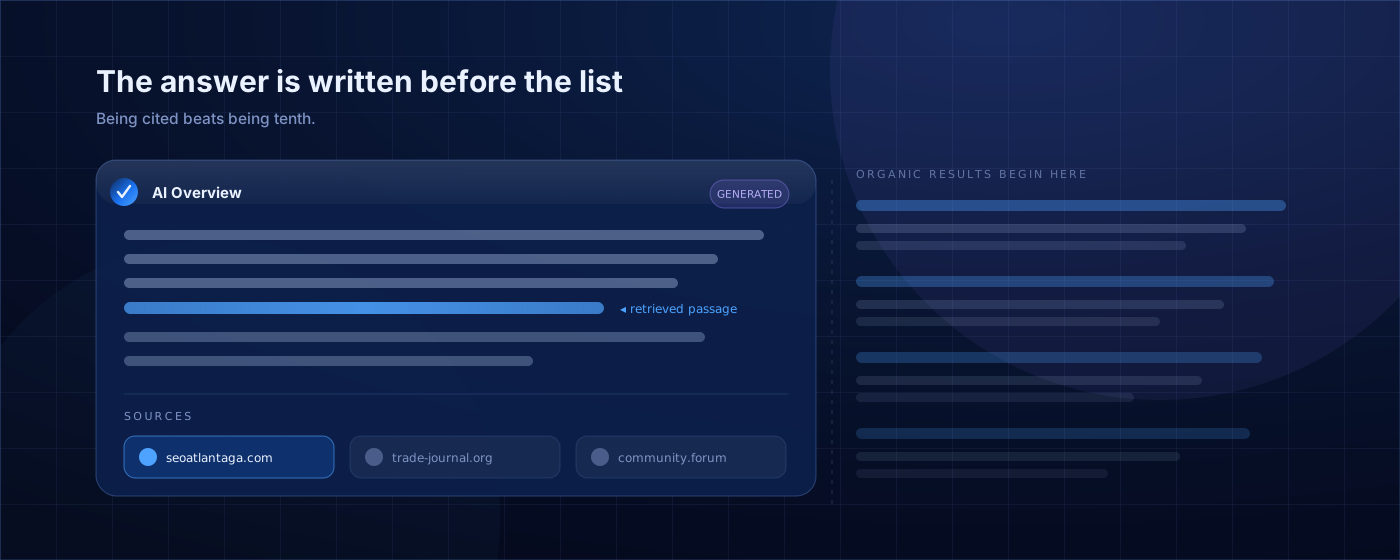
For twenty-five years a search engine's job was to hand you a list and let you choose. Now a growing share of queries return a composed answer — Google's AI Overviews, ChatGPT's search mode, Perplexity, Gemini, Copilot — assembled from sources the system selected and, usually, cited.
Two consequences follow, and they pull in opposite directions:
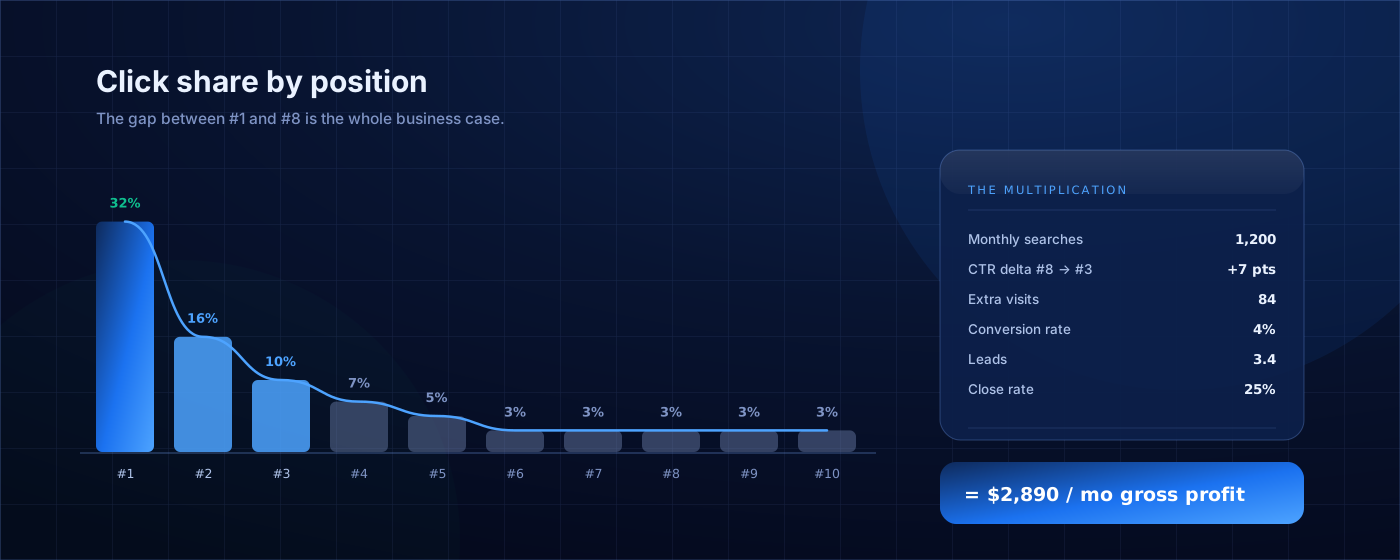
- Fewer clicks. If the answer is on the results page, a meaningful share of searchers never leave it. Informational queries take this hardest.
- Higher-value clicks. The people who do click through from a cited source have already had your business described to them favourably by a system they trust. They arrive further down the funnel than a blue-link visitor.
Answer engine optimization — AEO, sometimes generative engine optimization or GEO — is the work of being the source those answers are built from. It is not a replacement for SEO. It is a specialism inside it, with a different unit of optimization and a different success metric.
How an answer engine picks its sources
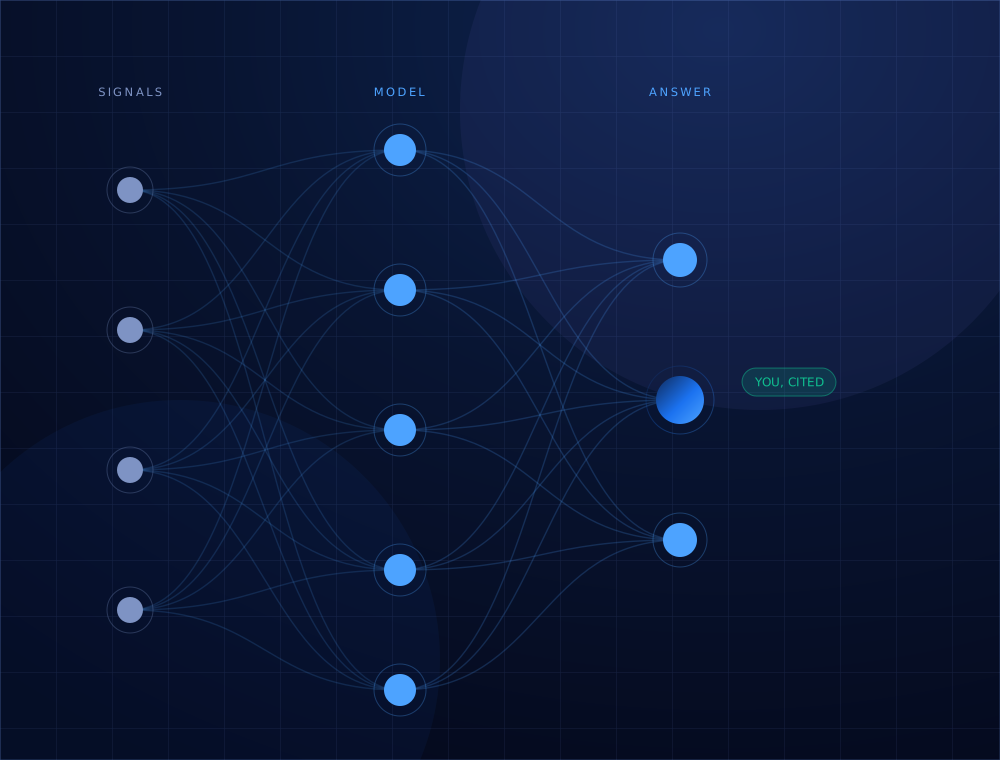
The pattern across current systems is broadly retrieval-augmented generation. Simplified:
- The user's question is interpreted and often broken into several sub-queries.
- The system retrieves candidate passages — chunks of pages, not whole pages — from a search index or its own crawl.
- It ranks those passages for how well they answer the specific sub-question.
- It synthesises an answer from the top passages and attributes the ones it leaned on.
Step two is the one that changes your job. The system is not asking "is this a good page about roofing?" It is asking "does this chunk of text answer *how much does a roof replacement cost in Atlanta* on its own?" A passage that only makes sense with three paragraphs of preceding context loses to a weaker but self-contained one.
Step one: check you are not blocked
This takes ten minutes and it is the most common reason a business is invisible to AI search. Open your robots.txt and look for these user agents:
| User agent | Belongs to | What it does |
|---|---|---|
GPTBot | OpenAI | Crawls for training and retrieval |
OAI-SearchBot | OpenAI | Search/browsing retrieval |
ClaudeBot | Anthropic | Crawls for Claude |
PerplexityBot | Perplexity | Indexes for Perplexity answers |
Google-Extended | Controls Gemini/Vertex use, not Search ranking | |
Bingbot | Microsoft | Feeds Copilot as well as Bing |
Plenty of sites picked up blanket blocks from a template, a plugin default, or a decision made in 2023 when the question looked different. Decide deliberately instead. Publishers monetising pageviews have a real argument for blocking. A service business whose content exists to win customers almost certainly wants to be cited — an AI answer naming your business is an endorsement you did not have to buy.
Google-Extended does not remove you from AI Overviews, which are built from Google's ordinary search index. The two controls are separate, and conflating them is a common and expensive mistake.Step two: write for passage retrieval
The structural changes are unglamorous and they work.
Answer first, elaborate after
Open every section with a direct, complete answer in one or two sentences, then expand. The lead sentence is what gets retrieved; the elaboration is what convinces the human who clicks through.
Make headings the questions people ask
A heading reading "Pricing" tells a retrieval system very little. "How much does commercial cleaning cost in Atlanta?" matches the query almost exactly and scopes the passage beneath it.
Keep passages self-contained
Avoid "as mentioned above," "this approach" and other references that only resolve with surrounding context. Assume every section will be read alone, because that is how it will be retrieved.
Use structure machines can parse
Comparison tables, numbered steps, definition lists and short bulleted criteria are all easy to lift cleanly. Long undifferentiated prose is not.
Be specific and attributable
Numbers, dates, named methods and stated sources make a passage more useful to cite and easier to verify. Vague, hedged writing gets passed over in favour of something concrete — which is a good reason to stop hedging in general.
Step three: make your entity unambiguous
Answer engines reason about entities — a business, a person, a product — not just strings of text. If a system cannot confidently resolve who "SEO Atlanta GA" is, it will not put your name in an answer.
- Schema markup defining your organisation, its identifiers and its relationships, consistently across the site.
- An about page that states plain facts: what you do, where, since when, for whom, by whom. Marketing language is not a substitute for facts.
- Consistent naming, address and description everywhere you appear.
- Named authors with real credentials, connected to their work.
This is the same entity-clarity work that has quietly underpinned E-E-A-T for years. AEO raises the stakes rather than changing the task.
What about llms.txt?
It is a proposed convention: a markdown file at your site root giving models a clean summary of the site and links to the pages worth reading. No major engine currently guarantees it uses one, so treat it as inexpensive insurance rather than a ranking factor. It costs an hour. Publish it, and do not expect it to do the heavy lifting.
Step four: get corroborated elsewhere
Here is the part on-page work cannot solve. Language models weight facts that appear consistently across independent sources. A claim that exists only on your own website is weakly supported; the same claim reflected in a trade publication, a local news story, a community forum and a supplier's site is something a model will repeat.
Practically, that means the boring old work matters more, not less: digital PR, local partnerships, industry mentions, and being genuinely present in the places your category is discussed. Forums and community sites carry unusual weight in AI answers for subjective and recommendation-shaped queries — which is worth knowing, and worth participating in honestly rather than gaming.
Measuring citation share
No rank tracker reports this natively, so build the measurement yourself:
- Write your prompt set. Twenty to fifty questions your buyers actually ask, phrased the way they phrase them to a chatbot — longer and more conversational than a Google query.
- Run them across the engines on a fixed schedule, and record which domains get cited and in what position.
- Track your share over time, alongside your competitors'. The trend is the metric; any single run is noisy, because these systems are non-deterministic.
- Watch referral traffic from
chatgpt.com,perplexity.aiand Copilot in analytics. Low volume, high intent, and it is the only part of this that shows up in a standard report.
AI Overview impressions are the hard case: they fold into ordinary Search Console data with no separate breakout, so direct prompt monitoring remains the honest measurement.
What this does to your traffic
Expect the mix to shift rather than the total to collapse — and expect the shift to be uneven.
- Definitional and informational queries lose the most clicks. "What is X" is exactly what an AI answers in place.
- Transactional and local queries hold up far better. People still want to click through to book, buy and call.
- Comparison and recommendation queries are where citation matters most, because being named is effectively a recommendation.
The strategic read: top-of-funnel content increasingly earns visibility rather than sessions, and you need measurement that can value a citation and not only a click. If your reporting only counts sessions, this channel will look like a loss even while it is working.
What to do on Monday
- Read your
robots.txtand make a deliberate decision about each AI crawler. - Ask ChatGPT and Perplexity the ten questions your best customers ask. Write down who gets cited.
- Take your three highest-value pages and restructure the top of each section: question as heading, complete answer in the first two sentences.
- Check your organisation schema resolves cleanly and your about page states verifiable facts.
- Set a monthly reminder to re-run the prompt set. The trend is the only number that means anything.
None of this is exotic, and that is the point. Answer engines reward content that is clear, specific, structured, credible and corroborated — which is what search engines have been claiming to reward for a decade. What changed is that vagueness now costs you the citation outright rather than a couple of ranking positions.
We do this work as a standalone engagement or as part of a broader programme — see answer engine optimization, or send us your site and we will run the prompt set for you.